
Hilton Hotels has scaled from its 1919 founding to a global hospitality leader, powered by disciplined marketing and relentless customer focus. The company operates across more than 126 countries, with a portfolio designed to win both leisure and business demand. Marketing fuels growth across loyalty, direct booking, and partnerships, turning brand equity into measurable revenue and lifetime value.
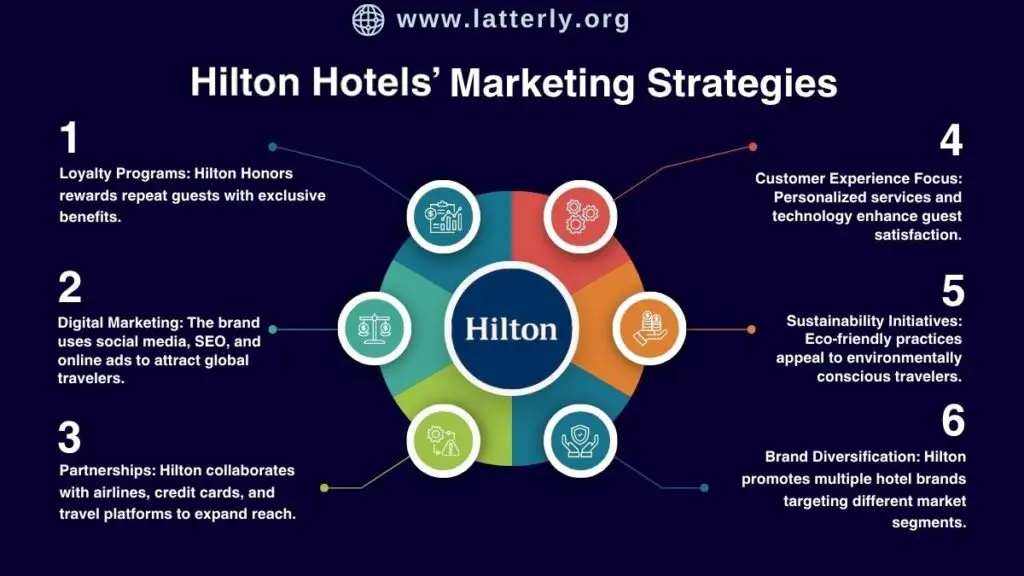
Hilton aligns its portfolio and loyalty engine with technology, content, and data to drive repeat stays at efficient acquisition costs. The company’s performance marketing, social storytelling, and enterprise partnerships reinforce a premium yet accessible positioning. This article outlines Hilton’s marketing framework, centered on Hilton Honors, direct digital channels, and global partnerships that scale engagement and profitability.
You may also find these guides helpful:
1. Hilton Competitors
2. Hilton Marketing Mix
3. Hilton SWOT Analysis
4. Hilton Business Model
Core Elements of the Hilton Hotels Marketing Strategy
In a hospitality market defined by choice, Hilton concentrates on customer lifetime value and asset-light expansion. The strategy prioritizes loyalty acquisition, mobile-led direct booking, and relevant content at every stage of travel planning. Portfolio breadth ensures coverage across price tiers, while partnerships add demand and experiential value.
Hilton organizes core marketing pillars into scalable levers that deliver efficient growth across brands and regions. These levers support consistent positioning, better channel economics, and greater conversion reliability for owners and franchisees. The elements also enable rapid testing and learning across campaigns, channels, and offers.
Growth Pillars and Value Drivers
- Loyalty engine: Hilton Honors membership drives frequency, upsell, and data-rich personalization across 22 brands and thousands of destinations.
- Direct booking focus: Mobile app, website, and call centers promote member rates, price transparency, and frictionless checkout, improving contribution margins.
- Partnership ecosystem: American Express co-branded cards, Lyft, and sports alliances expand relevance, earn rates, and brand reach.
- Portfolio strategy: Luxury to economy coverage captures diverse occasions, seasonal shifts, and group demand across regions.
- Owner value: Performance marketing, centralized revenue tools, and conversion programs strengthen property-level profitability.
Scale and data create compounding advantages across media, merchandising, and conversion. Hilton deepens these advantages with a standardized technology stack and unified identity management across channels. The result improves return on advertising spend and strengthens the brand moat in key urban and resort markets.
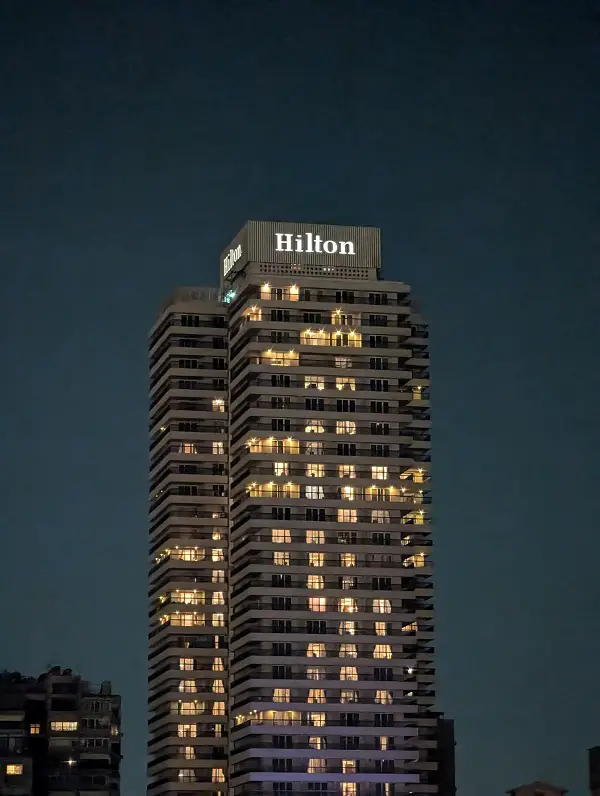
Hilton’s 2024 operating scale underscores the strategy’s effectiveness, with network reach, loyalty, and revenue expanding. The following metrics summarize current estimates and recently reported indicators that inform planning and investment priorities. Each metric links to specific programs that shape Hilton’s market presence.
Scale, Loyalty, and Revenue Indicators
- Global footprint: More than 7,600 properties and approximately 1.2 million rooms across 126 countries and territories in 2024.
- Loyalty members: Hilton Honors estimated at 185 million members in 2024, reflecting strong acquisition from co-branded cards and digital channels.
- Revenue: 2024 revenue estimated at 10.9 to 11.2 billion dollars, based on 2023 results and RevPAR growth trends.
- Pipeline: Record development pipeline estimated above 640,000 rooms, providing multi-year marketing and distribution leverage.
- Digital usage: Digital Key and Digital Check-in used hundreds of millions of times cumulatively, with accelerating adoption among members.
Hilton’s core marketing elements reinforce a cycle of data, scale, and efficiency that compounds over time. The approach converts customer trust into measurable demand and supports consistent growth across macro environments. This foundation keeps Hilton’s brands top of mind and strengthens systemwide performance.
Target Audience and Market Segmentation
Across travel categories, multi-occasion behavior is rising as guests mix work, leisure, and group events. Hilton segments audiences by trip purpose, price sensitivity, and loyalty status, then tailors offers and content by brand. The framework balances global demand patterns with local nuance, especially in high-growth APAC and Middle East markets.
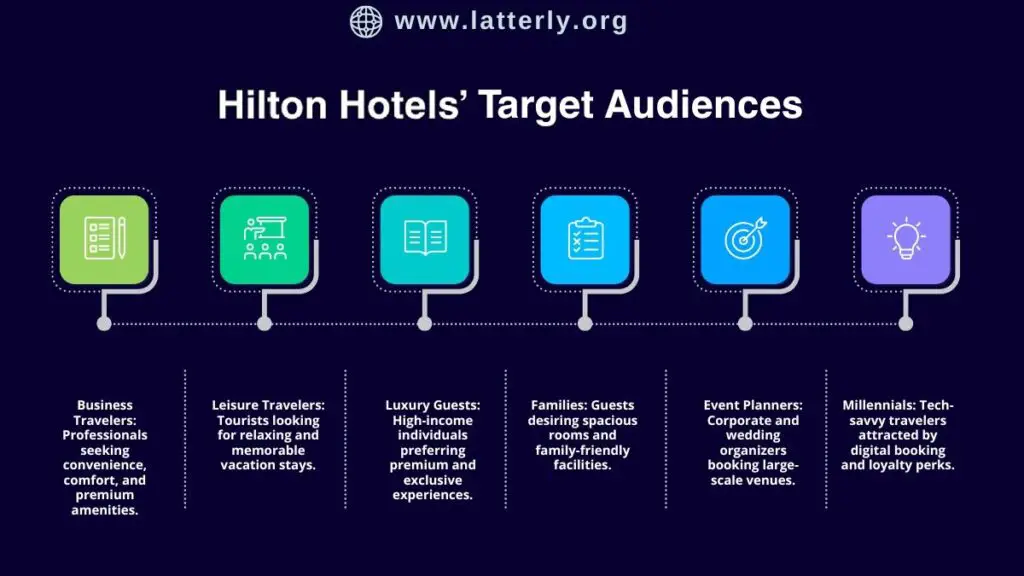
Hilton aligns brand promises with the specific needs of each segment, ensuring clarity and value. Premium and luxury flags emphasize design, culinary, and wellness, while focused-service brands prioritize reliability and convenience. Economy and extended-stay concepts address long-duration price needs without sacrificing cleanliness or digital convenience.
Primary Segments and Travel Occasions
- Corporate transient: Frequent weekday travelers value location, mobile access, and loyalty earn rates that influence policy compliance and repeat bookings.
- Leisure and family: Seasonal planners prioritize resort amenities, connecting rooms, and member-exclusive offers timed to school calendars and holidays.
- Luxury and premium: Aspirational guests seek branded residences, top-tier suites, and experiential dining that justify higher average daily rates.
- Value and economy: Price-focused travelers choose Spark by Hilton for dependable essentials, breakfast, and frictionless digital service.
- Extended stay: Project workers and relocators select LivSmart Studios or Home2 Suites for kitchens, workspace, and weekly pricing flexibility.
- Groups and meetings: Event planners require scalable space, catering, and tech support, anchored by Honors event rewards and negotiated packages.
Occasion-based planning guides channel mix, creative, and merchandising for each audience. Hilton adjusts messaging cadence for planning windows, from last-minute mobile to long-lead resort campaigns. These adjustments lift conversion while protecting rate integrity across segments.
Regional segmentation sharpens product-market fit where cultural expectations and payment behaviors differ. Localization spans language, amenities, and partnerships that simplify discovery and booking. This localization also improves paid media performance through higher relevance scores and lower acquisition costs.
Regional and Cultural Localization
- China and broader APAC: Localized apps, WeChat ecosystems, and widely used payment options streamline mobile-first planning and on-property service.
- Middle East: Family suites, privacy considerations, and culinary offerings reflect cultural preferences and longer average stays.
- Europe: City-center boutique experiences and rail-accessible locations cater to weekend leisure and short-haul business trips.
- Americas: Road-trip convenience, sports travel, and convention hubs capture seasonal peaks and large group demand.
- Resort corridors: All-inclusive and wellness experiences address extended leisure stays and premium rate opportunities.
Hilton’s segmentation model matches brand promises to audience needs with discipline and clarity. The approach improves campaign efficiency, protects pricing power, and increases loyalty engagement across regions. This segmentation engine continues to convert diverse demand into sustainable revenue growth.
Digital Marketing and Social Media Strategy
Travel discovery increasingly starts on mobile and social platforms where visual storytelling drives inspiration and intent. Hilton positions content, community, and conversion within a unified digital ecosystem anchored by the Hilton Honors app. The approach couples performance media with memorable brand storytelling that rewards members and accelerates direct booking.
Paid, owned, and earned channels work together to create compounding reach and lower-cost acquisition. Hilton prioritizes video, creator collaborations, and search visibility across high-intent queries. These priorities ensure top-of-funnel inspiration and bottom-funnel conversion operate in a single, data-informed workflow.
Platform-Specific Strategy
- Instagram and Reels: Destination reels, property spotlights, and guest stories build social proof and push followers toward member rates.
- TikTok: Long-form creative, including the widely reported ten-minute ad, generated tens of millions of views and strong engagement signals.
- YouTube: Pre-roll and mid-roll formats feature resort content, meeting solutions, and brand films that nurture trip planners.
- LinkedIn: Thought leadership and development pipeline updates support B2B trust with owners, planners, and corporate travel buyers.
- WeChat and regional platforms: Local mini-programs streamline discovery, service, and loyalty benefits in mobile-first markets.
- Email and SMS: Behavior-triggered journeys personalize offers using loyalty tier, location, and past-stay data.
The Hilton Honors app anchors direct demand with tools that reduce friction and elevate service. Features like Digital Key, room selection, and Connected Room enhance perceived value and drive repeat usage. These experiences differentiate Hilton while supporting a higher direct digital mix.
Technology and testing underpin continuous improvements in creative, merchandising, and pricing display. Hilton integrates analytics across media and web to refine audience selection and optimize formats. The stack connects to loyalty identity to coordinate frequency caps, offers, and content recommendations.
Owned-Channel Conversion Engine
- App engagement: Digital Key usage surpassed an estimated 150 million cumulative unlocks in 2024, reflecting member adoption and operational ease.
- Personalization: Adobe Experience Cloud and similar tools tailor rates, images, and add-ons to traveler profiles and trip context.
- SEO and content: Destination guides and property pages target high-intent queries, improving share of organic travel research.
- Testing discipline: Always-on A/B testing refines layout, copy, and offer sequencing to lift conversion and protect rate integrity.
- Metasearch: Strategic participation with clear parity rules captures intent efficiently while funneling repeat guests to direct channels.
Hilton’s digital strategy converts attention into reservations with efficient storytelling and well-instrumented customer journeys. The brand’s consistent creative, loyalty integration, and robust app utility strengthen direct economics. This integrated system builds durable advantages in awareness, consideration, and conversion.
Influencer Partnerships and Community Engagement
The creator economy shapes modern travel consideration, making authenticity and access critical to performance. Hilton partners with creators and communities to showcase experiences that feel real, useful, and bookable. These collaborations amplify the brand’s voice while nurturing advocacy that sustains long-term demand.
Hilton’s partnerships extend beyond content into exclusive experiences and loyalty value. The company prioritizes measurable outcomes, including tracked bookings, member sign-ups, and engagement quality. This rigor aligns creator programs with business impact rather than vanity metrics.
Creator Collaborations that Drive Bookings
- Brand campaigns: The Hilton. For the Stay. platform featured Paris Hilton and creator cuts that collectively achieved more than 50 million views worldwide.
- Experience access: Behind-the-scenes content at premium resorts and events increases aspiration and supports upsell into suites and packages.
- Sports integrations: Partnerships with properties tied to motorsport and major events enable creator hospitality content with clear booking pathways.
- Payments and perks: Co-branded card creators educate audiences on point earn rates, status boosts, and redemption strategies.
- Regional KOLs: Local influencers in APAC and the Middle East provide language-native credibility and highlight culturally relevant amenities.
Measurement centers on attribution models that connect content to direct digital bookings and loyalty actions. Hilton tracks unique offers, landing pages, and app events to evaluate cost per acquisition and lift. High-performing partners receive longer-term agreements that deepen consistency and efficiency.
Community engagement reinforces brand trust and local relevance around causes that matter to guests and team members. Programs focus on hospitality careers, disaster response, and environmental initiatives with measurable outcomes. These programs create goodwill that supports both reputation and recruitment.
Community Programs and Local Impact
- Hilton Global Foundation: Annual grants fund workforce development and environmental projects, with 2024 awards reported in the multimillion-dollar range.
- Volunteer initiatives: Team members contribute hundreds of thousands of service hours annually to community projects across key markets.
- Soap recycling: Partnerships with organizations such as Clean the World help recycle amenities and support global hygiene programs.
- Disaster relief: Property networks provide shelter and logistics support during emergencies, strengthening community resilience.
- Youth pathways: Career readiness programs introduce hospitality skills and create pipelines for local employment.
Hilton’s creator partnerships and community investments generate meaningful brand equity and attributable demand. The combined effect converts cultural relevance into performance outcomes that strengthen loyalty, direct booking, and long-term growth. This engagement model keeps Hilton visible, trusted, and preferred across audiences and markets.
Product and Service Strategy
Hilton aligns product design with revenue growth through a disciplined brand architecture, consistent service standards, and technology-led convenience. The group operates a diversified portfolio across luxury, lifestyle, full-service, and focused-service segments that balance rate and occupancy. Hilton projected approximately 11 billion dollars in 2024 revenue, supported by continued RevPAR growth and strong net unit additions. The product strategy enhances pricing power while protecting guest satisfaction across diverse travel occasions.
The portfolio includes flagship brands like Waldorf Astoria and Conrad, alongside growing lifestyle labels such as Canopy, Motto, and Tempo. Scaled brands like Hilton Hotels & Resorts, DoubleTree, Embassy Suites, Hampton, Tru, and Home2 Suites deliver dependable experiences that drive repeat stays. Collections brands Curio and Tapestry add conversion flexibility and distinctive narratives for independent owners seeking Hilton distribution. This structure allows efficient marketing segmentation without confusing the customer or diluting brand equity.
- 22+ brands: Coverage from luxury to economy, improving market reach and owner appeal across regions and asset classes.
- 7,600+ properties and roughly 1.2 million rooms globally in 2024, with a record pipeline estimated above 600,000 rooms.
- Lifestyle momentum: Tempo, Motto, and Canopy attract younger, experience-led travelers, reinforcing rate resilience in urban markets.
- Extended-stay strength: Home2 Suites and Homewood Suites address longer trips, boosting length of stay and optimizing housekeeping labor models.
- Collections conversions: Curio and Tapestry accelerate growth where ground-up development faces cost or zoning constraints.
Hilton integrates Hilton Honors into the product, linking booking, stay, and post-stay engagement within one experience loop. The Hilton app, Digital Check-in, and Digital Key reduce friction while building data signals for personalization. Connected Room capabilities enable streaming, in-room controls, and targeted offers that respect privacy preferences. These features strengthen perceived value compared with undifferentiated third-party booking experiences.
Hilton prioritizes service innovation to sharpen brand distinctiveness and drive share gains in corporate, leisure, and group segments. The focus includes meetings technology, food and beverage partnerships, and wellness additions that create memorably consistent moments. Each enhancement supports upsell opportunities, stronger review scores, and ancillary revenue growth.
Experience Design and Service Innovation
- Digital Key available across most of the portfolio, reducing front desk queues and elevating satisfaction scores for mobile-first travelers.
- Connected Room pilots broadened to additional brands, enabling app-based controls, content casting, and personalized preferences at scale.
- Event technology: Hybrid meeting setups, improved bandwidth, and collaboration tools position Hilton as a reliable choice for conferences and incentives.
- Wellness enhancements: Upgraded fitness spaces, healthier breakfast options, and sleep-focused amenities support premium positioning and review performance.
- On-property retail: Market-style grab-and-go formats create incremental revenue while catering to changing guest schedules and preferences.
Partnership-led services extend the product beyond the room through credit card earn-and-burn, mobility tie-ins, and entertainment access. The long-standing relationship with American Express delivers co-branded cards that accelerate points accrual, fund experiences, and encourage direct bookings. Sports and music collaborations, including the McLaren Formula 1 partnership, create high-impact moments that differentiate stays in key markets. The resulting ecosystem converts functional trips into emotionally resonant experiences that deepen loyalty.
Marketing Mix of Hilton
Hilton employs a classic marketing mix tuned for hospitality economics, integrating brand strategy, revenue management, and technology-enabled distribution. Product breadth supports precise positioning, while pricing models capture demand shifts throughout the week. Place translates into global scale and local relevance, and promotion activates loyalty to lower acquisition costs. The combined mix reduces reliance on intermediaries and secures healthier lifetime value.
Product strategy hinges on brand clarity and consistent delivery of the core promise in every segment. Luxury elevates service theatricality, while focused-service maximizes reliability and efficiency. Lifestyle brands emphasize design, locality, and social spaces that drive bar and restaurant revenue. Collections deliver character without sacrificing system standards or access to the Hilton platform.
- Luxury: Waldorf Astoria, Conrad, and LXR anchor premium ADRs with destination dining and signature experiences.
- Full-service: Hilton, DoubleTree, and Embassy Suites balance group, corporate, and leisure demand through flexible space and broad amenities.
- Lifestyle: Canopy, Tempo, and Motto attract younger demographics seeking design-forward stays and vibrant public areas.
- Focused-service: Hampton, Tru, and Garden Inn optimize cost-to-serve while maintaining strong review performance and loyalty capture.
- Extended-stay: Home2 and Homewood deliver kitchens and laundry access, lengthening stays and stabilizing occupancy.
Hilton’s place strategy leverages a wide geographic footprint that strengthens corporate account fulfillment and leisure reach. Urban cores, airport nodes, resort destinations, and interstate corridors create diversified demand streams. Development partnerships accelerate openings in high-growth regions while conversions unlock asset-light expansion. This coverage increases search visibility and availability across peak and shoulder periods.
Hilton amplifies demand through cohesive storytelling, targeted offers, and loyalty-led incentives aligned to each demand period. Promotional design supports revenue goals, with consistent themes that enhance direct channel preference. The approach uses digital media, partner integrations, and member benefits to compound performance across campaigns.
Promotional Architecture
- Hilton Honors membership exceeding an estimated 180 million in 2024, fueling lower-cost repeat bookings and richer first-party data.
- Member Rate pricing, app-only benefits, and exclusive experiences nudge guests to book direct and engage frequently.
- Co-branded credit cards with American Express expand earn velocity, fund point liabilities, and drive incremental stays.
- Always-on performance marketing combines search, metasearch, and retargeting to capture intent while protecting brand terms.
- Brand campaigns elevate consideration for new hotels, renovated flagships, and lifestyle entries in trend-leading neighborhoods.
The mix functions cohesively: product clarity attracts the right guest, place ensures availability, price optimizes yield, and promotion secures loyalty. This discipline supports RevPAR growth guidance around the mid-single digits for 2024 and steady net unit expansion. Strong alignment between brand promises and delivery reinforces Hilton’s premium over independents and weaker chains. The result is sustained share gain against online intermediaries and regional rivals.
Pricing, Distribution, and Promotional Strategy
Hilton’s commercial engine synchronizes pricing science, channel management, and offer design to maximize revenue quality. Advanced revenue management systems react to citywide events, comp-set shifts, and booking curves. Member-centric pricing and exclusive benefits increase conversion and reduce acquisition costs. The strategy prioritizes direct engagement while preserving reach for corporate and group needs.
Pricing relies on dynamic algorithms that balance occupancy and rate across weekdays, weekends, and seasons. Public Best Available Rates set transparent anchors, while Member Rate discounts provide controlled value without diluting brand. Corporate negotiated rates, group pricing, and length-of-stay fences segment demand efficiently. Ancillary pricing for parking, premium Wi-Fi, and upgrades strengthens total revenue per available room.
- Member Rate savings typically range from 2 to 10 percent versus public rates, encouraging direct booking and loyalty enrollment.
- Fenced offers: Advance purchase deals, extended-stay discounts, and flexible cancellation tiers match traveler priorities and risk profiles.
- Event-driven surges capture compression periods using pace analytics and competitor monitoring to protect ADR.
- Upsell pathways: Paid upgrades, premium views, and late checkout generate incremental margin with minimal operational strain.
Distribution emphasizes owned channels to safeguard margin and maintain control over the guest relationship. Hilton’s website, app, and call centers coordinate with property sales and global sales teams for corporate accounts. The company reports growing adoption of digital direct channels, with 2024 bookings estimated near half of system volume. Selective OTA and metasearch participation preserves visibility without ceding pricing leadership.
Promotional design converts demand pockets into action through clear value propositions and consistent loyalty mechanics. Always-on messages support brand familiarity, and periodic boosts create urgency during shoulder periods. Partnerships enrich offers with experiential hooks that differentiate Hilton from rate-only competitors.
Promotional Cadence and Offer Design
- Points accelerators: Double or triple points events stimulate short-term demand, calibrated to occupancy gaps by market and weekday.
- Co-brand card multipliers with American Express increase earn rates on Hilton spend, driving frequency and higher basket size.
- Experiential hooks: Access to concerts, sports, and McLaren Formula 1 activations turns stays into memorable redemptions.
- Direct booking perks: App-based check-in, Digital Key, and room selection create tangible reasons to avoid intermediaries.
- Geo-targeted offers and metasearch bids capture travelers within booking windows, improving return on ad spend efficiency.
The combined pricing, distribution, and promotional approach protects ADR while lifting occupancy through precisely targeted incentives. Stronger direct mix yields healthier flow-through and better personalization outcomes. Corporate, leisure, and group segments receive distinct value without confusing the marketplace. This disciplined engine underpins Hilton’s continued RevPAR outperformance and loyalty-led growth trajectory.
Brand Messaging and Storytelling
In a travel economy where travelers reward reliability, clarity, and genuine value, Hilton aligns its voice with practical outcomes. The brand focuses on the complete experience of the stay, not only the destination or journey. This positioning underscores convenience features, member-exclusive benefits, and the confidence earned through consistent service across thousands of properties. The result places Hilton’s messaging squarely on guest control, comfort, and trust at every booking and in-stay touchpoint.
Platform and Creative Themes
Hilton’s global platform, Hilton. For the Stay., positions the hotel stay as the decisive factor in trip satisfaction. The platform launched in 2022 and continued in 2024 with creative that combines humor and utility. Talent-led storytelling, including appearances from Paris Hilton, sparks attention while showing tangible value like flexible booking and on-property benefits.
- Core platform message: elevate the stay as the center of travel choices, emphasizing reliability, service, and control through the Hilton app.
- Content themes: convenience features such as Digital Key, Choose Your Room, and Confirmed Connecting Rooms that reduce friction and uncertainty.
- Channel mix: television, connected TV, YouTube, TikTok, Instagram, and brand.com content that translates utility into engaging creative formats.
- Creative development: partnerships with leading agencies and creators to localize work across regions while preserving a unified brand voice.
- Outcome focus: stronger brand preference at direct touchpoints where the platform connects storytelling to booking and loyalty enrollment.
Messaging extends to service-led narratives that link operational strengths with emotional rewards. Hilton highlights consistent brand standards, room cleanliness, and friendly staff moments as proof points. The company’s service culture, training programs, and guest recovery protocols support a promise the creative platform makes. This approach converts brand promises into real experiences that travelers can verify from check-in to check-out.
Content Formats and Owned Channels
Owned channels translate brand voice into practical guidance that speeds decisions and encourages direct booking. Hilton’s newsroom, Stories hub, and email programs package offers, destination content, and member education into actionable modules. CRM sequences personalize content with status, past behavior, and trip intent signals.
- Owned assets: Hilton.com, Hilton Honors app, Hilton Newsroom, and Stories pages that highlight benefits, program changes, and feature launches.
- Lifecycle communications: triggered emails for cart abandonment, price alerts, bonus point offers, and status progress updates.
- Performance intent: deep links from social and video to the app’s booking flow, strengthening the connection between inspiration and purchase.
- Search alignment: content structured for branded queries, loyalty terms, and value-driven keywords such as member rates and free night rewards.
- Regional nuance: localized assets that translate brand pillars into culturally relevant use cases without diluting global consistency.
Hilton’s messaging gains credibility when paired with visible program value, particularly for members who book direct. Hilton Honors membership, estimated at about 190 million in 2024, reflects the platform’s power to convert interest into loyalty. Clear positioning, relevant stories, and tangible utility create a cohesive narrative that sustains preference. The brand’s voice reinforces Hilton’s promise to make every stay simpler, more valuable, and easier to control.
Competitive Landscape
Global hospitality remains intensely competitive, with asset-light models, loyalty ecosystems, and owner value propositions shaping growth. Hilton competes with Marriott, IHG, Hyatt, and Accor on brand portfolio breadth, development pipeline, and digital experience. Scale still matters, but differentiated loyalty benefits and technology now influence conversion and repeat rate. Hilton uses a balanced mix of conversion-friendly brands and digital-led convenience to defend and grow share.
Market Position and Scale
Hilton’s development pipeline and loyalty base strengthen pricing power and distribution efficiency. The company operates across luxury, premium, midscale, and extended stay, supporting diverse owner economics. 2024 performance indicators suggest continued RevPAR growth with stable net unit expansion.
- System size: more than 7,500 properties and over 1.2 million rooms worldwide, across 22 brands that target distinct traveler needs.
- Pipeline momentum: an estimated pipeline exceeding 450,000 rooms in 2024, supported by conversion-friendly flags such as Spark and DoubleTree.
- Financial scale: 2023 revenue reached about 10.2 billion dollars, with 2024 revenue estimated near 10.9 billion dollars based on continued demand strength.
- Net unit growth: management guidance and industry estimates point to roughly 5 to 6 percent annual net unit growth across key regions.
- Geographic spread: broad coverage in the United States, Europe, the Middle East, and Asia Pacific, reducing single-market risk exposure.
Hilton’s portfolio strategy adds competitive flexibility by covering high-growth segments without diluting brand standards. Newer offerings such as Spark by Hilton accelerate conversion opportunities for owners, expanding the midscale footprint. Extended stay brands, including Home2 Suites, consistently deliver strong occupancy levels and resilient cash flows. The combined effect allows Hilton to address multiple demand pools through one loyalty and technology ecosystem.
Loyalty and Distribution Differentiators
Loyalty and direct distribution increasingly determine margin capture and long-term share. Hilton focuses on member value and mobile-led booking to limit dependency on intermediaries. The company’s owner proposition benefits from lower acquisition costs and repeat guest visibility.
- Hilton Honors scale: approximately 190 million members in 2024, providing a large addressable base for targeted offers and upgrades.
- Competitor benchmarks: Marriott Bonvoy above 200 million members, IHG One Rewards above 130 million, and Wyndham Rewards above 100 million.
- Direct channel emphasis: Member Rates, Best Price Guarantee, and app-exclusive features that reward direct purchase behavior.
- Technology edge: widespread Digital Key availability across more than 6,000 properties, integrating booking and access in one platform.
- Small business focus: the 2024 Hilton for Business program simplifies booking and benefits, creating an SMB moat rivals must counter.
Hilton’s position blends scale with a practical loyalty proposition that matters at the point of purchase. Consistent development momentum, balanced brand architecture, and differentiated distribution tactics form a durable competitive stance. Owners gain a clearer demand picture, while travelers enjoy recognizable value at every tier. This structure supports resilient growth even as competitor portfolios expand and reposition.
Customer Experience and Retention Strategy
In hospitality, retention grows fastest when loyalty, utility, and service come together in a single journey. Hilton builds that journey around Hilton Honors, the mobile app, and on-property consistency across brands and regions. The approach elevates convenience, transparency, and recognition as everyday benefits, not occasional perks. Members see value before, during, and after each stay, which strengthens repeat intent.
Hilton Honors Lifecycle and Benefits
Hilton Honors operates as the core engine for retention, linking booking incentives to on-property recognition. The program encourages frequent stays through milestone bonuses and strong elite benefits. Scale and simplicity help members understand the payoff of booking direct.
- Membership scale: an estimated 190 million members in 2024, representing a significant share of Hilton’s total occupied room nights.
- Tiered recognition: Silver, Gold, and Diamond status with benefits that include space-available upgrades, late checkout, and bonus points.
- Value drivers: Member Rates, 5th Night Free on standard room rewards, and no resort fees on award stays at participating properties.
- Flexibility: Points pooling, status extensions for life events, and targeted promotions that accelerate progress for leisure and business travelers.
- Conversion tools: personalized offers and price-aware nudges that shift intent from browsing to booking within the app or Hilton.com.
Hilton’s digital experience enhances retention by removing friction from trip planning and in-stay actions. Mobile check-in, Choose Your Room, and Digital Key allow guests to control arrival and room selection. Digital Key Share helps families and colleagues coordinate access without front desk delays. Consistent feature availability builds trust that transfers across brands and destinations.
Small Business and Co-brand Ecosystem
Business travelers and small companies contribute outsized lifetime value when programs solve real booking and expense challenges. Hilton targets that audience with platforms and financial partnerships that integrate rewards and recognition into daily operations. The result strengthens loyalty while improving cost visibility for employers.
- Hilton for Business: launched in 2024 for small and medium businesses, offering centralized booking, discounts, and points accrual for both companies and travelers.
- Co-branded cards: American Express Hilton cards provide accelerated earning, elite status, and annual free night awards that lock in repeat stays.
- Corporate usability: direct APIs, preferred rate loading, and consistent content help travel managers steer travelers to Hilton properties.
- Program synergy: elite recognition and on-property credits reinforce perceived value during every stay, not only during redemption events.
- Owner benefit: higher share of repeat business reduces acquisition costs and improves revenue predictability across markets.
Hilton ties retention to visible, everyday benefits that guests can recognize immediately. Strong loyalty mechanics, digital convenience, and practical small business solutions encourage members to return and book direct. The model converts recognition into habit, ensuring more stays from guests who value control and consistency. This strategy sustains durable lifetime value across segments and regions.
Advertising and Communication Channels
Global hospitality advertising increasingly favors digital video, search, and measurable retail media. Hilton deploys an integrated communications plan that supports direct booking, Hilton Honors acquisition, and premium brand preference across 22 distinct brands. The platform centers on Hilton. For the Stay, which elevates the experience angle and showcases tangible on-property advantages for members. This approach links upper-funnel storytelling to lower-funnel conversion paths that deliver efficient revenue at scale.
Creative must travel across markets, formats, and devices without fragmenting the core promise. Hilton builds flexible assets that adapt to property, segment, and language while maintaining consistent value messages for member rates and benefits. Strong performance feedback loops inform media mix changes quickly across seasons and booking windows.
Platform-Specific Strategy
Channel strengths vary significantly; Hilton assigns roles across awareness, consideration, and conversion to minimize overlap and waste. The media plan pairs reach channels with searchable demand capture, reinforcing value propositions at decisive moments. The result sustains brand salience while protecting price integrity and maximizing direct revenue contribution.
- Connected TV and digital video extend reach to cord-cutters, then drive measured lift in branded search volume and app installs among travel intenders.
- Paid search captures high-intent demand; Hilton optimizes return on ad spend across brand, destination, and long-tail property terms across seasons.
- Metasearch partnerships highlight Member Exclusive rates, maintain price parity, and funnel shoppers into direct booking paths with transparent, localized inventory.
- Airport and sports venue out-of-home placements reinforce premium awareness among frequent travelers, complementing digital retargeting that closes near-term demand.
Partnerships amplify brand experiences that content alone cannot achieve. Hilton activates hospitality access with McLaren Racing, Live Nation, and major event hosts to create memorable, sharable moments for members. These executions feed owned channels with footage, testimonials, and limited-time offers that convert excitement into stays.
- The McLaren partnership delivers trackside hospitality, creator integrations, and localized race-week assets that stimulate premium bookings and corporate demand.
- American Express co-brand messaging integrates across email, app, and video, exchanging richer welcome bonuses for higher lifetime value cohorts.
Hilton allocates spend using incremental lift studies, media mix modeling, and multi-touch attribution that validate both brand and performance roles. The system shifts budgets toward assets proving incremental direct bookings, higher average daily rates, and more Hilton Honors enrollments. This unified communications engine consistently elevates awareness while compounding direct channel economics for the portfolio.
Sustainability, Innovation, and Technology Integration
Travelers reward brands that reduce impact and elevate convenience without sacrificing value. Hilton embeds sustainability and product innovation into the stay, using data to reduce costs and improve guest satisfaction. The strategy links property-level operational improvements with digital experiences that speed service and personalize moments. These investments protect margins, advance reputation, and enable pricing power across segments.
Hilton’s Travel with Purpose framework sets 2030 targets for carbon, energy, water, and waste, tracked through the proprietary LightStay platform. LightStay covers managed and franchised properties, standardizing measurement, benchmarking, and continuous improvement. The program strengthens owner economics and aligns procurement, maintenance, and food operations with measurable environmental outcomes.
Technology Stack and Product Integration
Guest-facing technology must feel simple while hiding substantial operational complexity. Hilton prioritizes features that reduce friction, increase control, and deepen loyalty engagement across the app and property systems. The roadmap focuses on practicality that scales across brands and countries without training burdens.
- Digital Key and Digital Key Share enable secure room access, elevator calls, and parking entry, improving satisfaction while reducing front desk queues during peaks.
- Connected Room controls lighting, temperature, and streaming preferences, persisting profiles across stays to personalize environments automatically at check-in.
- OnQ and revenue systems integrate with CRM and the app, enabling tailored offers, ancillary upsells, and service recovery that improve lifetime value.
- The Tesla partnership expands thousands of universal chargers across hotels, creating the largest planned overnight charging network in hospitality.
Operational sustainability initiatives translate directly into marketing proof points and owner benefits. Soap recycling with trusted nonprofits, food waste tracking, and energy retrofits reduce cost while strengthening community impact. LightStay reporting supports corporate travel RFPs that increasingly require verifiable sustainability performance across global portfolios.
- Properties deploy efficient HVAC, LED retrofits, and smart sensors, lowering utility expenses while improving environmental scores that influence enterprise procurement.
- Culinary teams implement waste analytics and diversion programs, reducing cost per cover and improving guest satisfaction with fresher menu engineering.
Hilton positions innovation as service, not novelty, ensuring features materially enhance the stay and the P&L. This discipline scales technology that matters, deepens loyalty engagement, and signals responsible growth to corporate buyers and consumers. The combined focus anchors premium positioning across a broad and diverse network.
Data Analytics and Performance Measurement
Marketing accountability requires clear metrics linking spend, channels, and customer value. Hilton operates a data stack spanning media, CRM, property systems, and loyalty to produce timely performance views. Teams monitor conversion paths and profitability, then shift budgets and experiences toward cohorts and offers that deliver incremental returns. Owners gain confidence through transparent reporting, while guests receive more relevant messaging and benefits.
Revenue management and commercial analytics align demand forecasting with rate strategy and inventory controls. System-wide RevPAR grew strongly in 2023; management guided for continued expansion in 2024. Current industry trends suggest mid-single-digit RevPAR growth in 2024 versus 2023, with business transient and international markets improving.
Key Performance Metrics
Consistent measurement centers on variables that reflect both growth and efficiency. Hilton emphasizes metrics that link to cash flow, loyalty depth, and channel quality. The framework balances near-term bookings with long-term customer value creation.
- System-wide RevPAR is estimated to grow approximately four to five percent in 2024, reflecting resilient demand and disciplined commercial execution.
- Hilton Honors membership likely exceeds 185 million in 2024, based on recent acquisition trends and higher digital conversion rates.
- Direct digital mix is estimated in the low-to-mid thirties percent of room nights, supported by app adoption and member-exclusive pricing.
- Paid media efficiency targets sustained double-digit return on ad spend, validated with incrementality testing and media mix modeling across large markets.
Customer analytics feed segmentation, content, and pricing experiments that influence path-to-purchase length and trip value. Teams evaluate app engagement, email responsiveness, and upsell acceptance to refine on-site and pre-arrival offers. Insights inform capital allocation toward brands, markets, and features that produce higher contribution margins.
- Test-and-learn roadmaps prioritize statistically significant experiments on landing pages, rate displays, and bundling, focusing on conversion and average daily rate.
- Loyalty dashboards track member cohort retention, ancillary attachment, and cross-brand propensity, guiding targeted benefits that accelerate multi-brand stay behavior.
Hilton’s analytics culture treats marketing as an investment that must compound. The organization scales programs that prove incremental profit, trims tactics that underperform, and keeps teams focused on quality growth. This discipline sustains brand momentum through cycles and supports stronger owner returns.
Future Outlook and Strategic Growth
Hospitality growth increasingly depends on pipeline velocity, brand adjacency, and direct channel strength. Hilton enters 2025 with a robust development pipeline, expanding in premium economy, extended stay, lifestyle, and luxury. The company delivered record signings in recent periods and sustained net unit growth near the high end of peers. Marketing will support these openings with targeted demand generation, loyalty offers, and local market partnerships.
Hilton reported 2023 revenue above ten billion dollars and continued to grow system-wide demand. Based on guidance and travel trends, 2024 revenue likely lands near 11.0 to 11.3 billion dollars. The portfolio spans approximately 7,600 properties across more than 120 countries, providing diversified demand sources and attractive owner economics. New brands broaden reach without diluting core positioning around service and reliability.
Strategic Priorities for Expansion
Platform expansion requires rigorous brand architecture, disciplined capital allocation, and loyalty advantages that persuade repeat stays. Hilton concentrates growth where guests demonstrate willingness to trade up for certainty, convenience, and value. Partnerships and digital investments reinforce differentiation in crowded urban and resort markets.
- Spark and LivSmart Studios extend the customer funnel, adding efficient conversion points for value seekers and long-stay workers across secondary markets.
- Luxury and lifestyle growth accelerates in gateway cities, leveraging Waldorf Astoria, Conrad, and Canopy to attract premium leisure and corporate travelers.
- Development priorities emphasize Greater China, India, and the Middle East, supported with owner services, localized content, and enterprise sales scale.
- Direct booking programs expand member-exclusive rates, flexible benefits, and app-first servicing, strengthening economics and member attachment across brands.
Hilton Honors remains the engine for diversified demand, with estimated membership surpassing 185 to 190 million in 2024. Co-brand credit expansion, experiential rewards, and elite recognition increase switching costs and stay frequency. The combination of brand breadth, disciplined development, and direct channel depth positions Hilton for durable, profitable growth through varied cycles.
