
Launched in 2001 by Jimmy Wales and Larry Sanger, Wikipedia transformed the early web into a participatory knowledge commons. Built as a faster, more open complement to Nupedia’s expert review, it harnessed wiki software so anyone could edit, cite, and improve articles. Today it remains one of the most visited sites on the internet, stewarded by the nonprofit Wikimedia Foundation.
Its target market is everyone who seeks quick, free, and multilingual information, from students and teachers to journalists, researchers, and the casually curious. Because search engines surface Wikipedia prominently, it often serves as the first stop in the information journey. The combination of broad coverage, zero cost, and instant accessibility makes it a dominant starting point.
Wikipedia’s appeal rests on policies like neutral point of view, verifiability through citations, and transparent edit histories. These strengths position it as a general purpose reference, even as some users look to specialized or curated alternatives for depth, authority, or different editorial models.
Key Criteria for Evaluating Wikipedia Competitors
When comparing Wikipedia to other knowledge platforms, focus on the factors that drive trust, usability, and long term value. Use the criteria below to match an alternative to your use case, governance needs, and budget.
- Accuracy and editorial oversight: how content is verified and corrected. Look for citation standards, expert involvement, and workable dispute resolution.
- Depth and coverage: breadth across topics, plus depth within specialized domains. Check for regional and niche content, historical context, and updated bibliographies.
- Ease of use and discoverability: interface clarity, search quality, navigation, and mobile performance. Good information architecture shortens time to answer.
- Update speed and timeliness: latency from event to publication, and frequency of revisions. Speed and transparency matter for news, science, and policy.
- Transparency and governance: open edit histories, moderation rules, and contributor accountability. Clear policies foster trust and reduce hidden bias.
- Cost, licensing, and reuse: free access, subscription fees, and terms for commercial reuse. Open licenses like CC BY-SA enable reuse and integration.
- Ecosystem and integrations: APIs, data exports, and compatibility with CMS and LMS tools. Plugins and developer support expand utility.
- Privacy and data practices: tracking, advertising, and account requirements. Minimal data collection and strong controls protect users and organizations.
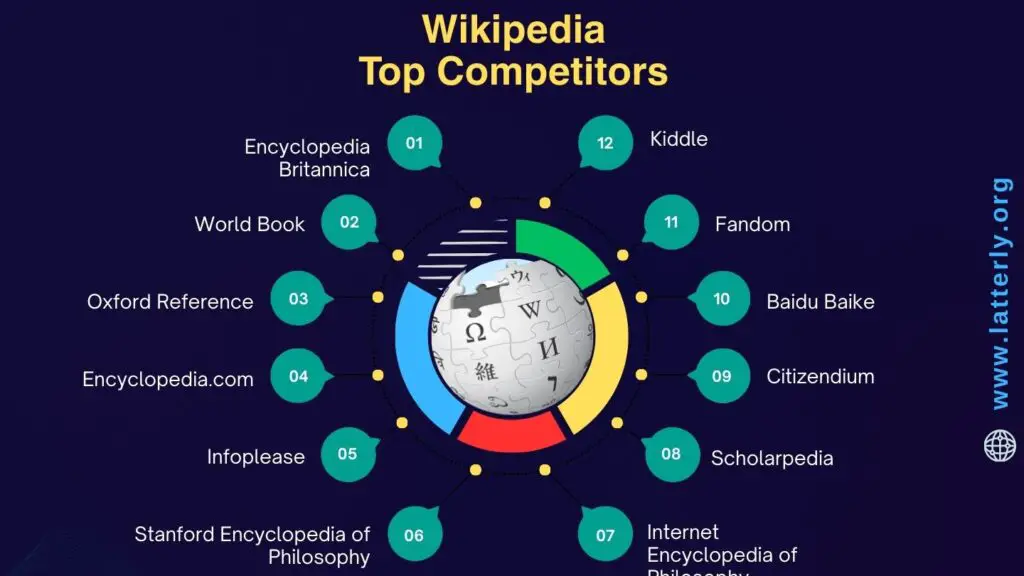
Top 12 Wikipedia Competitors and Alternatives
Encyclopedia Britannica
Few reference brands carry the prestige of Encyclopedia Britannica, a name synonymous with editorial rigor and academic trust. Its online platforms offer carefully curated articles written and reviewed by subject specialists. For readers who want vetted summaries and citable overviews, Britannica delivers a dependable alternative to open editing models.
- Strengths include expert authorship, structured fact checking, and consistent editorial style across disciplines, which promotes clarity and reliability for students and professionals.
- Britannica maintains strong market presence in schools, universities, and libraries, supported by institutional subscriptions and educator resources.
- Product categories span Britannica Academic, Britannica School, Britannica Kids, and multimedia reference collections, giving age appropriate pathways to core knowledge.
- Consumers consider it an alternative to Wikipedia because it provides stable, citable entries that are less prone to anonymous edits or fluctuating quality.
- Notable features include curated bibliographies, primary source links, timelines, and topic pages that organize complex subjects into navigable modules.
- Differentiators include clear authorship credentials, revision oversight by editors, and reading level support that helps learners progress from introductory to advanced content.
World Book
World Book has been a classroom staple for generations, known for accessible explanations and student friendly design. The brand has evolved from print sets to robust digital platforms used by schools and libraries worldwide. Educators value its consistent reading levels and curriculum aligned tools.
- Strengths center on clarity, carefully graded reading levels, and rich illustrations that support comprehension for K 12 learners.
- Market presence is anchored in education, with widespread adoption by school districts and public libraries seeking reliable general reference.
- Product categories include World Book Student, Kids, Advanced, and eBooks, plus educator portals with lesson plans and assessment ideas.
- It serves as an alternative to Wikipedia when schools require controlled vocabulary, vetted updates, and safe search experiences for younger readers.
- Advantages include guided research features, citation tools, and topic trees that help learners build background knowledge before moving to primary sources.
- Differentiators include consistent editorial voice across reading levels, integrated learning supports, and content that maps to academic standards.
Oxford Reference
Drawing from Oxford University Press’s dictionaries and companions, Oxford Reference delivers concise, authoritative entries across the humanities, social sciences, and sciences. It is designed for quick fact checking and foundational overviews. Scholars and students use it to anchor research with citable, expert crafted definitions.
- Strengths include editorial consistency, specialist authorship, and breadth that spans language, literature, history, philosophy, and STEM fundamentals.
- Its market presence is strong in academic libraries and research institutions that license cross searchable collections for campus wide use.
- Product categories feature Quick Reference for fast lookups and the Oxford Reference Library for deeper, article length treatments.
- As an alternative to Wikipedia, it offers concise, citable summaries with clear provenance and stable page versions suited for formal research.
- Advantages include embedded bibliographies, subject overviews, and related content navigation that speeds up literature scanning.
- Differentiators include premium dictionary level precision, editorial boards for major subject areas, and integration with other Oxford digital resources.
Encyclopedia.com
Encyclopedia.com aggregates entries from established reference publishers, giving readers a centralized way to explore vetted content. Topic pages pull from multiple sources, which helps triangulate definitions and perspectives. For quick overviews with citations to original works, it is a practical starting point.
- Strengths lie in aggregation, which surfaces content from reputable encyclopedias, dictionaries, and thesauruses in one interface.
- Its market presence spans students, educators, and general readers who want free access to reference style summaries.
- Product categories include encyclopedic articles, dictionary entries, images, and related resources connected through topic hubs.
- It is considered an alternative to Wikipedia because it offers sourced entries with publisher attributions, improving traceability for citations.
- Advantages include multiple viewpoint entries on the same topic, links to full source records, and clear bibliographic details for further research.
- Differentiators include a focus on publisher backed content and cross references that reduce time spent chasing definitions across sites.
Infoplease
Infoplease combines an encyclopedia, almanac, dictionary, and calculators to serve students and curious readers who need quick facts. The site organizes timelines, statistics, and concise explanations in a user friendly format. It excels at fast lookups when breadth matters more than depth.
- Strengths include an almanac rich approach, easy navigation, and concise entries that support homework help and trivia level needs.
- Infoplease has a broad consumer audience, with strong utility for families, teachers, and lifelong learners seeking reliable quick reference.
- Product categories span encyclopedia entries, timelines, conversion tools, biographies, and country profiles with key stats.
- As an alternative to Wikipedia, it provides compact, curated facts with fewer tangents, which helps keep research focused.
- Advantages include built in calculators, conversion widgets, and study tools that extend beyond text based reference.
- Differentiators include a strong almanac tradition, integrated fact boxes, and topical guides that reduce the need to search multiple sites.
Stanford Encyclopedia of Philosophy
Within academic philosophy, the Stanford Encyclopedia of Philosophy is widely regarded for its rigorous, peer reviewed entries. Articles are written and maintained by experts, and updates are logged transparently. It functions as a living reference that scholars trust for authoritative coverage.
- Core strengths are expert authorship, formal peer review, and comprehensive bibliographies that guide deeper research.
- Market presence is strongest in universities and among independent scholars who need citable, discipline specific articles.
- Its product category is a single, open access encyclopedia devoted to philosophy, with structured sections and revision histories.
- Readers choose it over Wikipedia for philosophy topics because it offers stable, academically curated articles with explicit authorship.
- Advantages include extensive references, related entry crosslinks, and summary sections that aid both novices and experts.
- Differentiators include a living article model with scheduled updates and editorial oversight by field editors.
Internet Encyclopedia of Philosophy
The Internet Encyclopedia of Philosophy provides open access, peer reviewed articles aimed at students and general readers. Its entries balance clarity with academic depth, making complex concepts approachable. Many instructors assign IEP readings as preparatory material before journal articles.
- Strengths include accessible prose, peer reviewed coverage, and topic breadth spanning historical and contemporary philosophy.
- It has strong visibility in academic syllabi and is frequently cited in course materials as a reliable secondary source.
- Product categories include comprehensive topic entries, philosopher biographies, and overviews of schools of thought.
- As an alternative to Wikipedia, it offers identifiable authorship, editorial screening, and a consistent structure for learning.
- Advantages include suggestions for further reading, glossary support, and clear sectioning that improves comprehension.
- Differentiators include a student centered tone that preserves rigor while reducing jargon and ambiguity.
Scholarpedia
Scholarpedia blends wiki technology with expert authored, peer reviewed articles, focusing strongly on science and mathematics. Contributors are invited or proposed based on subject reputation, and submissions undergo scholarly review. The result is a hybrid model that prizes authority and stability.
- Strengths center on invited authorship, peer review, and stable curated versions that readers can cite confidently.
- Its market presence is notable in technical research communities, including computational neuroscience and dynamical systems.
- Product categories emphasize deep review style entries on specialized scientific concepts and methods.
- It serves as an alternative to Wikipedia when readers need authoritative, less volatile treatments of advanced topics.
- Advantages include formal references, mathematical rigor, and editorial control that reduces inconsistent quality.
- Differentiators include author accountable revisions, curator roles for stewardship, and stable version archiving.
Citizendium
Citizendium positions itself as a more accountable wiki, emphasizing verified identities and expert guidance. The project encourages collaboration while reducing anonymity, which aims to limit vandalism and improve quality. Its community is smaller, but the editorial philosophy is distinctive.
- Strengths include a real name policy, structured workgroups, and mechanisms for expert approval on mature articles.
- Market presence is modest, yet it appeals to contributors who value civility and transparency of authorship.
- Product categories mirror a general encyclopedia, with topic clusters and subpages for bibliographies and related resources.
- It is considered an alternative to Wikipedia by readers who prefer oversight and verifiable contributor identities.
- Advantages include reduced edit warring, clearer accountability, and a culture that prioritizes source quality.
- Differentiators include expert approved article statuses and governance that blends community input with editorial review.
Baidu Baike
Baidu Baike is the dominant Chinese language encyclopedia, integrated tightly with Baidu’s search ecosystem. Its massive user base and localized coverage make it a primary reference point for Mandarin speakers. The platform balances community contributions with moderation policies suited to its market.
- Strengths include scale, strong coverage of Chinese culture and local topics, and seamless exposure through Baidu search results.
- Its market presence is extensive in Mainland China, where it serves as a default reference for many users.
- Product categories encompass general encyclopedia entries, media attachments, and reference style infoboxes.
- It is an alternative to Wikipedia for Chinese readers, particularly where access to Wikipedia may be restricted or less localized.
- Advantages include fast updates on regional subjects, deep coverage of domestic organizations, and standardized formatting.
- Differentiators include search integration that elevates Baike pages, plus community incentives that grow content breadth quickly.
Fandom
Fandom hosts thousands of community built wikis that dive deep into entertainment, gaming, and niche interests. Its pages often capture granular details and lore that exceed general encyclopedias. For subject specific research and fan driven documentation, the platform is unmatched in scope.
- Strengths include enthusiastic contributor communities, rapid updates, and extraordinary depth in pop culture and gameplay mechanics.
- Market presence is global, with millions of pages and active editors across franchises, studios, and indie projects.
- Product categories revolve around individual wikis with custom templates, infoboxes, and visual enhancements.
- Users treat it as an alternative to Wikipedia when they need franchise level details, canonical timelines, or patch specific changes.
- Advantages include discussion forums, versioned histories, and specialized templates that standardize complex data.
- Differentiators include a platform purpose built for fan communities, complete with monetization that sustains hosting at scale.
Kiddle
Kiddle focuses on kid friendly encyclopedic content and a safe search experience tailored to younger audiences. Articles use simplified language and curated sources to support early learners. Teachers and parents rely on it to introduce research skills without overwhelming complexity.
- Strengths include age appropriate writing, prominent visuals, and careful curation that filters out unsuitable material.
- Its market presence is strongest in elementary and middle school classrooms, homeschool settings, and family use.
- Product categories include encyclopedia style pages, topic hubs for school subjects, and image libraries with safe filters.
- It functions as an alternative to Wikipedia when children need accessible explanations and a low distraction environment.
- Advantages include reading level consistency, simple citations, and navigation designed for emerging readers.
- Differentiators include stricter content policies for safety, plus educator friendly layouts that support assignments and projects.
Top 3 Best Alternatives to Wikipedia
Encyclopaedia Britannica
Britannica stands out for rigorous editorial oversight, expert-written entries, and a consistent neutral tone. Its articles are concise, carefully sourced, and supported by multimedia that adds helpful context. The service maintains high credibility for academic and professional use.
- Key advantages: fact-checked authority, clear citations, classroom and library friendly formats, and strong cross-referencing.
- Best for: students, educators, and professionals who need trustworthy summaries and stable references for research or teaching.
Encyclopedia.com
Encyclopedia.com aggregates content from reputable reference works, bringing dictionaries, encyclopedias, and thesauri together in one search. It stands out for quick, broad coverage across disciplines, which is ideal for getting reliable overviews fast. The platform typically includes citations and related resources for deeper study.
- Key advantages: wide scope from multiple publishers, consistent citations, easy cross-references, and free access to many entries.
- Best for: general readers and students who need a quick snapshot with sources, plus writers who want concise definitions and background.
Scholarpedia
Scholarpedia offers peer-reviewed articles written by invited experts, especially strong in physics, neuroscience, and computational sciences. It stands out for scholarly rigor, signed authorship, and curator oversight that keeps entries accurate and current. The format resembles academic publishing, which supports reliability and citability.
- Key advantages: peer review, stable versioning, deep bibliographies, and technical clarity for complex topics.
- Best for: researchers, graduate students, and advanced learners who need authoritative, in-depth explanations in STEM fields.
Final Thoughts
There are many strong alternatives to Wikipedia, ranging from general reference platforms to peer-reviewed specialty resources. Each shines in different ways, including editorial rigor, speed of updates, depth of coverage, or convenience. This variety gives learners and professionals many reliable paths to high quality information.
The best choice depends on your goals, budget, and subject area. If you want broad, curated summaries, Britannica is a natural fit, while Encyclopedia.com is excellent for quick multi-source overviews. For technical or scholarly depth, Scholarpedia provides vetted, citable content.
Use the alternative that matches your needs, and do not hesitate to combine sources for a fuller picture. With a thoughtful approach, you can build a research workflow that is accurate, efficient, and confidence inspiring.
