
Spotify is the world’s leading audio streaming platform, connecting hundreds of millions of listeners with music, podcasts, and a growing slate of audiobooks. The app pairs a vast licensed catalog with algorithmic playlists like Discover Weekly and features such as DJ that tailor sessions to each user. With seamless access across phones, speakers, cars, and wearables, Spotify has become a daily audio companion for global audiences.
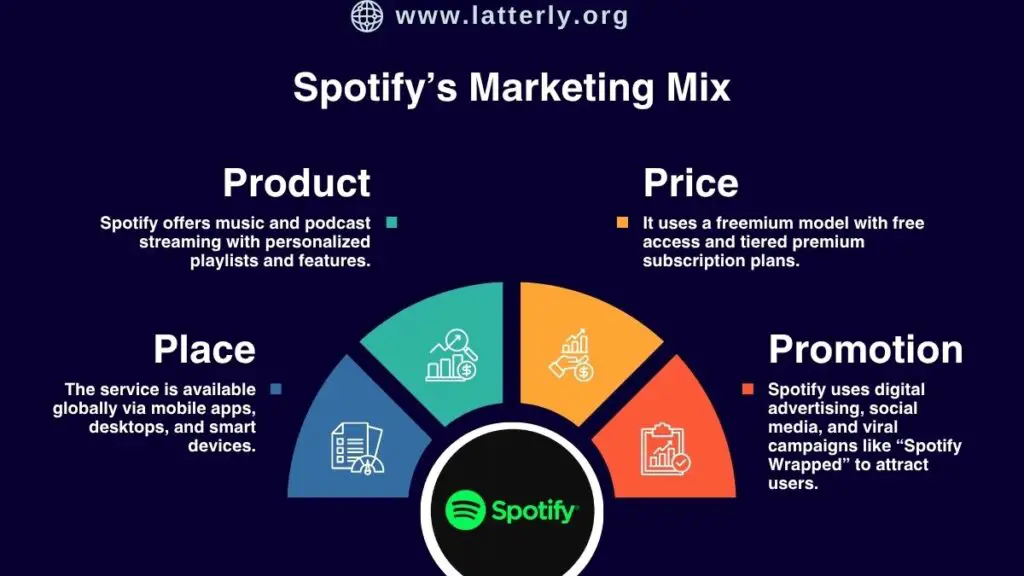
Understanding Spotify through the marketing mix clarifies how the company scales engagement, differentiation, and monetization across diverse markets. The 4Ps framework shows how product choices, pricing tiers, distribution partnerships, and promotion reinforce one another to acquire users and reduce churn. Framing the strategy this way illuminates the levers behind growth, creator value, and advertiser demand.
It also helps contextualize recent shifts, including price adjustments and a deeper focus on profitable formats like podcasts and audiobooks. Together, these choices shape how Spotify balances scale with sustainable unit economics.
You may also find these Spotify guides helpful:
1. Spotify Marketing Strategy
2. Spotify Branding Strategy
3. Spotify SWOT Analysis
4. Spotify Business Model
5. Top Spotify Competitors
Company Overview
Founded in Stockholm in 2006 by Daniel Ek and Martin Lorentzon, Spotify launched in 2008 with a mission to transform access to music. The company pioneered an on demand streaming model that paired licensed catalogs with a user friendly, freemium experience. Today it operates globally with a dual focus on consumer delight and creator opportunity.
Spotify’s core business spans Premium subscriptions, a free ad supported service, and a growing podcasts and audiobooks ecosystem. It runs a two sided marketplace, offering listeners discovery and convenience while providing creators and publishers with distribution, analytics, and monetization. The platform invests heavily in personalization, editorial programming, and partnerships with major labels and independent rights holders.
The brand holds a leading position among global audio streaming services by users and subscribers, serving audiences in more than 180 markets. Competition includes Apple Music, Amazon Music, YouTube Music, and regional players, which pushes continuous innovation and localized strategies. Recent priorities include price optimization, disciplined content investments, and ad technology that improves measurement and returns for marketers.
Product Strategy
Spotify’s product strategy blends content breadth with personalization and ubiquitous access to build daily habit. It aligns feature design with segmentation, discovery, and creator tools to reduce friction and increase lifetime value. The following pillars show how product choices support growth and monetization at scale.
Tiered Freemium Model With Audience Segmentation
Spotify balances reach and revenue with a freemium structure that converts demand into paying relationships over time. The free tier drives top of funnel discovery with ads and feature limits, while Premium options like Individual, Duo, Family, and Student unlock offline listening, higher quality, and control. Select markets add audiobook hours, time limited mini plans, or telecom bundles to match local willingness to pay and speed upgrades.
AI Personalization and Discovery Ecosystem
Algorithmic recommendations such as Discover Weekly, Release Radar, Daily Mixes, Blend, and the DJ feature adapt in real time to listening signals. Editorial and algorithmic playlists work together to surface new and catalog tracks, deepening engagement and extending the long tail. These systems power habit formation, improve satisfaction, and lower churn by making every session feel tailored and fresh.
Multi Format Expansion into Podcasts and Audiobooks
Spotify has expanded beyond music to become a multi format audio hub. Podcasts include open distribution, creator tools, video support, and monetization via dynamic ad insertion and subscriptions, while selective originals complement licensed shows. Audiobooks, available in many markets with a monthly listening allowance for Premium, add differentiated value and create cross category discovery moments that enhance retention.
Two Sided Platform and Creator Tools
The platform serves creators with Spotify for Artists analytics, playlist pitching, and marketing products like Marquee and Showcase. Podcasters access creation, hosting, and monetization through integrated tools and the Spotify Audience Network. Merch, live events, and fan engagement features deepen relationships, aligning creator success with listener satisfaction and reinforcing network effects that attract more content.
Ubiquitous Access via Cross Platform Integrations
Spotify reduces friction by being available wherever listening happens. Spotify Connect enables control across speakers and devices, while integrations span Android Auto, Apple CarPlay, smart speakers, TVs, consoles, and wearables. Offline downloads, data saver modes, and cross device handoff ensure reliable playback in varied network conditions and use cases worldwide, supporting consistent, high quality sessions.

Price Strategy
Spotify’s pricing architecture is designed to grow scale while lifting average revenue per user through clear value signals. The company balances an accessible free tier, segmented paid plans, and localized rates with periodic adjustments tied to new features such as audiobooks. This approach aligns willingness to pay with content breadth and convenience.
Freemium Anchor and Upgrade Path
The ad-supported free tier sets a reference point that showcases the catalog while preserving meaningful incentives to upgrade. Functional limits such as no offline listening and restricted on-demand access in certain contexts encourage migration to Premium. By keeping discovery friction low and experience differences clear, Spotify uses freemium as a performance channel that steadily converts heavy listeners who value control, convenience, and uninterrupted playback.
Tiered Plans for Households and Students
Spotify structures pricing by life stage and household size with Individual, Duo, Family, and Student tiers. Duo targets cohabiting couples who want separate accounts and recommendations, while Family serves up to six accounts with parental controls and Spotify Kids. The Student plan lowers price with verification, maintaining early loyalty. Periodic list price updates in markets like the United States reflect increased content value and evolving cost structures.
Localized Pricing and Micro-subscriptions
To match purchasing power and local competition, Spotify calibrates prices by market and experiments with formats beyond monthly billing. In select countries, it has offered mobile-only or time-limited access passes that reduce commitment barriers and support cash-based or prepaid behaviors. This localization improves accessibility, expands the addressable audience, and drives sustainable adoption in emerging markets where standard subscriptions can be a higher share of wallet.
Bundles with Telcos and Device Makers
Partnership pricing through mobile operators, broadband providers, and OEMs lowers acquisition cost and simplifies payments. Offers can include extended trials, discounted months, or consolidated carrier billing that reduces churn from payment failures. Hardware tie-ins with smart speakers, TVs, or smartphones add perceived value at purchase. These bundles place Spotify in the checkout flow, shifting price evaluation from a standalone decision to part of a larger package.
Value Pricing with Audiobooks and Feature Differentiation
Spotify increasingly prices to delivered value by packaging capabilities and content. In the United States, United Kingdom, and other markets, Premium includes a monthly allotment of audiobooks listening hours, while a Basic Individual option in some regions excludes audiobooks at a lower price. Clear feature separation around offline listening, multi-device control, and content breadth helps justify list price, manage ARPU, and segment users by needs.
Place Strategy
Spotify’s distribution emphasizes ubiquity, ensuring listeners can start on one device and continue on another with minimal friction. The company combines deep platform coverage, hardware integrations, and partnerships that lower onboarding effort. This omnipresence supports daily use across home, commute, work, and leisure moments.
Multi-platform App Distribution
Spotify is available on iOS, Android, Windows, macOS, and a lightweight web player, which makes access possible even on locked-down computers. In bandwidth-constrained markets, Spotify Lite in select regions reduces app size and data usage. Consistent login and library sync across platforms ensure continuity, while app store placement and high rating density improve organic discovery and reinstall rates.
Spotify Connect and Hardware Partnerships
Spotify Connect lets phones act as remotes while speakers and receivers stream directly, improving stability and battery life. Partnerships with brands such as Sonos, Bose, and Samsung enable native controls, multi-room playback, and quick switching between devices. Support for AirPlay and Chromecast extends reach further, making premium listening effortless across living rooms, offices, and studios without cables or manual pairing complexity.
In-car Listening via CarPlay and Android Auto
Spotify integrates with Apple CarPlay and Android Auto, placing core controls on the dashboard where drivers need them. Many automakers also support native or deep integrations in infotainment systems to reduce setup time. Voice integration improves safety and accessibility. By anchoring the commute use case, Spotify increases daily frequency, protects share from radio, and maintains continuity between home and mobile listening.
Smart TVs, Wearables, and Consoles
Native apps on smart TVs and streaming platforms put Spotify in the living room for parties, workouts, and ambient listening. PlayStation and Xbox integrations turn consoles into media hubs, while Apple Watch and Wear OS support quick controls and offline playlists for Premium on the go. This presence across screens and contexts creates habitual touchpoints that deepen engagement and retention.
Telco Bundles, Preloads, and Carrier Billing
Distribution is reinforced through preloads on selected devices, promotional placement in OEM app galleries, and telco co-marketing. Direct carrier billing simplifies payment for users without credit cards and reduces friction at renewal. Partnerships with mobile and broadband providers place Spotify in sales scripts and self-serve portals, turning service activation moments into high-conversion distribution channels for both free trials and paid upgrades.
Promotion Strategy
Spotify markets through a blend of performance, brand storytelling, and product-led promotion anchored by personalization. Always-on messages inside the app complement seasonal campaigns that travel across social, out of home, and creator channels. The strategy converts free listeners, reignites dormant users, and builds cultural relevance.
Always-on Freemium Funnel
The free tier doubles as a promotional channel with upgrade prompts tied to moments of perceived value. In-app banners, interstitials after ads, and contextual messaging around offline playback or skips educate users on Premium benefits. This product-led marketing leverages first-party signals, delivering timely offers that raise trial starts and lower customer acquisition costs compared with external media.
Spotify Wrapped and Data-driven Storytelling
Each year, Spotify Wrapped turns listening data into personalized stories that users share widely. The campaign extends across social platforms, creator collaborations, and eye-catching out of home, driving organic downloads and reengagement. Artists receive bespoke assets and insights, amplifying reach through their communities. Wrapped showcases product differentiation in personalization while reinforcing brand warmth and cultural conversation.
Artist Partnerships and Fan Programs
Spotify partners with artists on exclusive sessions, playlist takeovers, and live or pop-up events that create moments fans want to talk about. Fan First emails offer top listeners presales and merch, rewarding engagement. These initiatives generate earned media, strengthen the artist value proposition, and position Spotify as an active participant in music culture rather than a passive utility.
Performance Marketing and Introductory Offers
Paid search, social, and app store ads target high-intent audiences with creative that highlights convenience, discovery, and Premium benefits. Retargeting nudges lapsed users with personalized reasons to return. Time-bound introductory offers, like one to three months of Premium for eligible new users in select markets, reduce perceived risk and accelerate adoption while maintaining price integrity outside of promotional windows.
Podcast and Owned Media Cross-promotion
Spotify uses house inventory across playlists, podcast ad breaks, and the home feed to spotlight Premium, audiobooks, and editorial hubs. The Spotify Audience Network and Megaphone extend campaigns to off-platform podcasts with audience targeting. By blending owned and paid channels, Spotify reaches listeners in context, reinforces product narratives, and efficiently scales campaigns that convert habitual listening into paid relationships.
People Strategy
Spotify’s people strategy balances the needs of listeners, creators, and advertisers across a global platform. The company invests in specialized teams that improve discovery, safety, and support, while empowering artists and podcasters to build sustainable audiences. Talent depth in data science and editorial curation underpins a service used in hundreds of markets.
Creator Success and Education Programs
Spotify prioritizes creator enablement through education, analytics, and promotion. Initiatives like Spotify for Artists and Spotify for Podcasters consolidate insights, marketing tools, and audience data in one place, helping creators refine release strategies. Programs such as RADAR, EQUAL, and Fresh Finds surface emerging voices with editorial support. Creator-facing documentation, webinars, and case studies translate best practices into growth, reinforcing a marketplace where artist outcomes improve alongside listener satisfaction.
Editorial Curation and Cultural Leadership
Global and local editorial teams shape taste and discovery through branded playlists like RapCaviar, Viva Latino, and Today’s Top Hits. Editors collaborate with data analysts to blend cultural context with signals such as saves, skips, and completion rates. Seasonal franchises, live sessions, and takeover campaigns amplify moments that matter in each region. This human plus data approach builds trust with listeners and acts as a flywheel for breaking artists.
Data Science, Personalization, and Research
Machine learning engineers, data scientists, and researchers optimize recommendations across Home, Search, and Radio. Teams experiment with user embeddings, natural language processing, and audio analysis to power features like Discover Weekly, Daylist, and AI DJ. Quantitative research is paired with qualitative studies to reduce bias and cold start issues. Continuous model evaluation ensures recommendations adapt to taste shifts and context, sustaining daily engagement.
Trust, Safety, and Policy Operations
Spotify’s policy, integrity, and moderation teams safeguard the platform by enforcing published Platform Rules. They handle content labeling, sensitive topics, and intellectual property complaints, coordinating with rights holders and industry bodies. Investments in detection tooling, escalation playbooks, and human review improve response times. Clear appeal paths and transparency reports strengthen accountability, while creator guidance helps prevent issues before they arise.
Customer Support and Community Care
Listener and creator support is delivered through multilingual help centers, authenticated contact forms, and an active community forum. Social support channels address quick fixes and triage complex cases. Help articles are continuously updated to reflect new features, price changes, or audiobook inclusions where available. Proactive prompts inside the app reduce friction, guiding users through billing questions, plan eligibility, and device setup.
Process Strategy
Spotify’s operating processes are designed for scale, reliability, and rapid iteration. From onboarding to billing, the service reduces friction while maintaining compliance and safety. Behind the interface, advanced experimentation and content supply chain controls power consistent improvements to discovery and monetization.
Friction-Light Onboarding and Freemium Funnel
Signup flows emphasize low effort entry, quick genre and artist selection, and immediate playback. Freemium provides broad access with advertising, while Premium trials, student, duo, and family plans target specific needs. Contextual upsell messaging focuses on ad-free listening, downloads, and added benefits like audiobooks in supported markets. Lifecycle emails and in-app nudges progress users from new to retained, then to paid.
Continuous Experimentation and Personalization
Spotify runs large scale A B tests on layouts, ranking, and messages to improve engagement and retention. Models incorporate behavioral signals, textual metadata, and audio features to rank tracks, episodes, and audiobooks. Guardrails prevent regressions in satisfaction or diversity. Rollouts are staged, with holdouts and long term measurement to capture habit formation effects, ensuring changes benefit both creators and listeners.
Content Ingestion, Metadata, and Rights Management
Ingestion pipelines accept music, podcasts, and audiobooks via labels, distributors, and creator tools, adhering to industry standards and territory rights. Automated validation checks metadata quality and flags duplicates and mismatches. Rights windows, takedowns, and edits are processed with audit trails. Improved credits, lyrics, and translations enhance search and context, while fingerprinting and partner coordination reduce spam and infringing content.
Payments, Pricing, and Plan Verification
Billing systems support diverse payment methods and local currencies, with proration and refunds aligned to regional rules. Spotify adjusts pricing by market and communicates changes through in app notices and email. Eligibility checks verify student status and manage household plans. Self serve tools handle upgrades, downgrades, and audiobook hour top ups where applicable, decreasing support load and involuntary churn.
Reliability, Security, and Incident Response
Engineering teams operate a multi region architecture with edge caching to reduce latency and buffering. Observability, SLOs, and on call rotations shorten time to detect and resolve incidents. Regular chaos testing and dependency reviews harden critical paths like playback and payments. Security practices, including encryption and coordinated vulnerability disclosure, protect user data while enabling rapid product development.
Physical Evidence
Spotify’s brand is experienced through consistent visual, product, and environmental cues that reassure users and partners. The app’s interface, editorial brands, and high visibility campaigns signal quality and scale. Tangible assets across retail and devices reinforce trust at every touchpoint.
Distinctive App Interface and Brand Identity
The dark theme, green palette, circular imagery, and clean typography make the app instantly recognizable across iOS, Android, web, and desktop. Consistent navigation, the Connect icon, and clear download indicators communicate capability and status. Microinteractions, waveform visuals, and animated transitions convey polish. Store listings, release notes, and screenshots mirror the in product look, validating authenticity before install.
Branded Editorial Playlists as Signposts
Playlists like RapCaviar, New Music Friday, and Viva Latino feature consistent cover art systems and descriptive copy that function as visual anchors. Badges, takeover banners, and artist features turn these sets into recognizable destinations. The design language signals curation quality and credibility. Seeing these brands across social posts and billboards reinforces that listening on Spotify connects to a broader culture.
Wrapped delivers personalized cards, stories, and videos each year, optimized for social sharing and mobile screens. The bold typography, color gradients, and data visualizations serve as proof of usage and taste. When feeds fill with Wrapped posts, social proof compounds. Artists receive their own assets and thank you messages, creating a virtuous loop of recognition that validates the platform.
Spotify Codes, Connect, and Device Integrations
Scannable Spotify Codes on posters, artist pages, and merch link directly to content, acting as tangible proof in the real world. Spotify Connect pairing on speakers, TVs, cars, and consoles shows the service running beyond the phone. Presence on CarPlay and Android Auto dashboards, plus remote controls on wearables, communicates ubiquity and reliability.
Retail Gift Cards and Partner Visibility
Physical gift cards at electronics chains, supermarkets, and convenience retailers extend trust through established storefronts. Co branded materials with telcos, device makers, and student programs underline legitimacy during bundle signups. In store displays, window decals, and checkout racks display the logo and pricing clearly. Receipts, redemption emails, and confirmation screens provide immediate proof of value and activation.
Competitive Positioning
Spotify competes from a position of scale, data, and relentless product iteration. Its platform blends a massive global audience with machine learning, enabling differentiated discovery and engagement loops that are difficult to replicate. Layered formats, creator tools, and flexible pricing strengthen the value proposition for listeners, artists, and advertisers alike.
Global Scale and Personalization Moat
With over 600 million monthly active users and more than 240 million Premium subscribers as of 2024, Spotify benefits from unrivaled listening data that fuels personalization. Flagship features such as Discover Weekly, Daily Mix, Daylist, and the AI DJ routinely refresh content relevance. This continuous feedback loop increases time spent, reduces churn, and improves conversion from free to paid, reinforcing a durable competitive moat rooted in both audience reach and recommendation quality.
Multi Format Audio Ecosystem
Spotify’s catalog strategy spans music, podcasts, and audiobooks, giving listeners one destination for long and short form audio. The integration of podcasts and expanding audiobooks access in Premium drive cross format discovery and incremental engagement. This breadth diversifies revenue between subscriptions and advertising while increasing switching costs, since users consolidate listening habits, libraries, and recommendations in a single, continuously improving interface.
Freemium Funnel Efficiency
Spotify’s ad supported tier remains a powerful acquisition engine, widening the top of the funnel in both mature and emerging markets. Product nudges, tailored trials, and family, duo, and student plans convert high intent users efficiently. Price localization and periodic increases demonstrate growing pricing power, while the freemium model allows Spotify to scale rapidly, gather training data, and monetize users through ads until they are ready to upgrade.
Creator and Marketplace Capabilities
Tools like Spotify for Artists, Marquee, Showcase, Discovery Mode, and podcast creation suites encourage creators to invest in the platform. These offerings improve audience development and monetization, aligning incentives across the two sided marketplace. As Spotify deepens analytics and promotional utilities, it positions itself as an indispensable partner for labels, independent artists, and podcasters seeking predictable reach and measurable campaign outcomes.
Pricing, Bundling, and Partnerships
Through tiered plans, periodic price updates, and new add ons such as higher quality audio options rolling out in select markets, Spotify can segment willingness to pay. Partnerships with telecoms, device makers, and automotive platforms extend distribution and reduce acquisition costs. Bundles and household plans help defend share against rivals by embedding Spotify in everyday contexts where convenience and continuity matter.
Challenges and Future Opportunities
Spotify’s next phase requires disciplined margin expansion while maintaining product velocity. The company navigates licensing dynamics, evolving ad markets, and shifting platform rules, even as AI opens new possibilities for discovery and creator tools. Balancing innovation with responsible rights management will shape both growth and industry relationships.
Royalty Costs and Marketplace Upside
Licensing and royalty expenses remain the largest structural cost, pressuring gross margins. Continued migration toward marketplace tools that influence merchandising, promotion, and discovery can create higher margin revenue streams. By proving incremental value to rights holders and creators, Spotify can justify performance based economics that improve unit economics while still supporting sustainable payouts and catalog investment.
Podcast Strategy and Advertising Monetization
After scaling back exclusive spend, the focus has shifted to platform wide monetization through the Spotify Audience Network, video podcasts, and better measurement. The opportunity lies in improving ad targeting, dynamic insertion, and self serve tools for mid market advertisers. Demonstrating consistent profitability in podcasting will validate the multi format thesis and smooth revenue cyclicality.
Pricing Power and ARPU Optimization
Recent price increases in multiple regions showed resilience, but sensitivity varies across markets. Spotify can expand ARPU through add ons such as lossless audio, audiobook hours, and premium features for families and power users. Careful experimentation with bundles, annual plans, and regional localization can unlock revenue without accelerating churn, especially in price sensitive developing markets.
Platform Rules and Payments Flexibility
App store policies and regional regulations affect in app commerce, marketing, and customer relationships. Ongoing regulatory shifts in the EU and elsewhere create openings for alternative billing and direct communication that could lower acquisition and payment processing costs. Navigating compliance while improving the purchase experience will be key to increasing direct subscriber relationships and lifetime value.
AI Enabled Discovery and Responsible Rights Management
Generative and assistive AI promise better recommendations, creator productivity, and new formats like DJ and personalized mixes. The risk lies in rights, attribution, and potential catalog clutter. Spotify can lead with transparent labeling, licensed training data, and creator centric controls, turning AI into a differentiator that enhances discovery while maintaining trust with artists, labels, and listeners.
Conclusion
Spotify’s marketing mix is anchored by a freemium engine, data driven personalization, and a multi format catalog that keeps users engaged and converts them to paid tiers. Its scale, creator tools, and growing pricing flexibility reinforce a clear position as the default destination for streaming audio in many markets.
Looking ahead, disciplined execution on margin expansion, ad monetization, and responsible AI can unlock the next stage of profitable growth. By aligning incentives across listeners, creators, and rights holders, Spotify can deepen loyalty, differentiate the brand, and sustain leadership in a rapidly evolving audio landscape.
